 Zetrixweb
Test Automation & QA Strategy: The Complete Playbook
Test pyramid, tool selection, flakiness reduction, release gates, and how to evaluate a QA partner.
10 min read
Read article
Browse our rewritten library of practical, step-by-step guidance for engineering, product, growth, and AI leaders.
Trending Now
Test pyramid, tool selection, flakiness reduction, release gates, and how to evaluate a QA partner.
Pick the right revenue model, define upgrade triggers, and validate pricing without eroding trust.
Understand the delivery systems and engineering quality needed for native mobile success.
All Articles
Each article is fully rewritten with useful content, clear examples, and delivery insights for modern product teams.
Microservices solve scaling problems most startups do not have yet. A modular monolith keeps your options open without the distributed-systems tax.
Teams lose the reasoning behind decisions faster than they lose the code. A one-page ADR per decision fixes that for almost no cost.
The model call is the smallest part of a production LLM system. The layers around it decide whether it survives real traffic.
Slow, confusing Power BI reports usually trace back to one flat table or a tangle of relationships. A star schema fixes both.
Import is fast but needs refresh. DirectQuery is fresh but depends on the source. Direct Lake aims for both on Fabric.
Row-level security does not apply to workspace editors, and test content ends up in front of executives. Governance fixes both before they happen.
Fabric trades some flexibility for far less integration work. Whether that trade is good depends on your team, stack, and cost model.

Bronze keeps what arrived, silver makes it trustworthy, gold makes it useful. On Fabric, that structure also decides how well Power BI performs.
Nobody can give a reliable date for superintelligence. You can still build the organization that copes with it, and with every AI step before it.
The prompt scaffolding you wrote for last year's model can quietly hold this year's model back. Design so upgrades are measurable and cheap.
Deflection rate alone doesn't prove a chatbot paid for itself. The fuller scorecard US SMBs should use before calling it a win.
A SOC 2 report gets an AI startup in the room. It doesn't answer the newer question enterprise security teams are asking about model calls.
PHI doesn't have to touch a general-purpose AI feature for it to be useful. The back-office wins that hold up under HIPAA are scoped around that exact line.
A rule engine needs a code change for every policy update. A well-built compliance agent adapts without a full engineering sprint - if it stays auditable.
Not every e-commerce automation problem needs an agent. Here's where a Claude agent genuinely outperforms a simpler workflow tool.
US privacy law is no longer just a California problem for AI chatbots. Here's what the growing state patchwork actually requires.
An off-the-shelf AI tool is the right starting point for most startups - until your differentiation depends on something it wasn't built to do.
A slick AI demo gets a first meeting. What gets a term sheet is proof the product's AI behavior is genuinely defensible, not a thin wrapper.

Exception handling, not routine tracking, is where a Claude agent earns its cost in a US logistics operation.
The AI engineering hiring market in the US is tight. A well-governed offshore delivery model is often the faster path to shipping, not just the cheaper one.

Most business AI features land in the EU AI Act's limited-risk tier, not the high-risk one founders fear. Here's how to tell the difference.

Where a chatbot's underlying model processes EU customer data is a real GDPR question - not a detail to leave for the audit.

Claude doesn't replace a sensor-based predictive maintenance system - it reads the language-heavy documents around it that no sensor pipeline touches.
RPA breaks the moment a UI changes. A Claude agent reasoning about the task is a fundamentally more durable kind of automation.
A Digital Product Passport needs structured, accurate data. AI's job is extracting it from scattered documents - not deciding what the data should say.
Translating an English chatbot's replies isn't the same as understanding a customer's actual question in their own language.

Winning a public-sector AI contract in the EU means proving things a private enterprise deal rarely asks for.

PSD3 raises the bar on fraud monitoring and dispute handling documentation. A Claude agent fits as a first-pass assistant - not as the control itself.
Data sovereignty isn't a later-stage enterprise problem for an EU-facing MVP - customers and investors ask about it earlier than most founders expect.
Smaller EU businesses aren't behind on AI because they don't see the value - it's a specific, addressable resourcing gap, and available funding often goes unclaimed.
Explainability and human oversight aren't abstract MAS expectations - they're specific design choices a fintech AI deployment has to make concretely.

PDPA's consent and purpose-limitation principles apply directly to a chatbot's conversation logs - here's what a compliant setup looks like.

GovTech vendor work in Singapore rewards vendors who can prove reliability and explainability up front - not just build a good demo.

Singapore's logistics volume runs through multiple carriers, customs regimes, and freight documents - exactly the exception-heavy work a Claude agent handles well.
Singapore's fast-moving startup market means an MVP that takes six months to validate is already behind. Here's what to prioritize instead.
Each ASEAN market a Singapore-based AI product expands into has its own data protection rules. Here's a practical, non-paralyzing way to approach it.

Singapore's linguistic diversity isn't served by picking one primary language and translating - it needs support that reasons natively across all four.
Hosting your own model infrastructure means owning a full-time operational burden most startups don't need to carry - here's when it's actually worth it.
Compliance policy scattered across wiki pages and tribal knowledge is a real operational risk. Packaging it into a maintained Skill fixes that.

Lease terms, tenancy correspondence, and listing management are language-heavy, high-volume work - a strong match for a well-scoped Claude agent.
What actually goes inside a support Skill - escalation rules, policy tables, tone, templates - and the mistakes that make one unreliable.
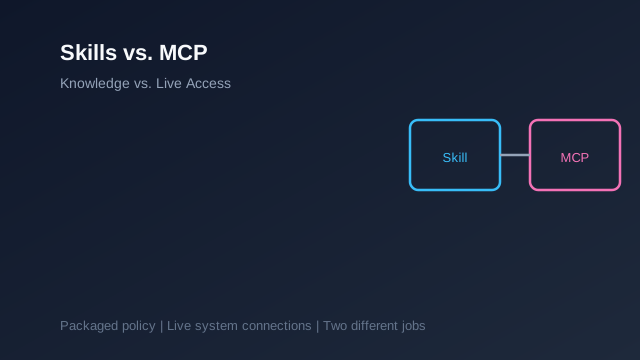
Skills package knowledge and policy. MCP gives live access to systems. Confusing the two is the most common design mistake in Claude deployments.
Why the document-dump approach goes stale, and how connecting one system at a time with proper permission scoping actually holds up.
Before picking an approach, ask if you need an agent at all. Then use the harness-vs-deployment framework to pick the right one.
Computer use pays off on legacy desktop software and no-API vendor portals - but it needs more caution and staged rollouts than a normal integration.
A scheduled deployment gives you per-firing run records and lifecycle controls a cron job never had. What actually belongs on a schedule.
Retrieval, policy, and model behavior are three distinct problems with three distinct fixes. Most businesses never actually need fine-tuning.
A first-pass review assistant flags what a lawyer should look at first, with citations back to the source clause for every claim.
Most workflows need one agent done well, not a team. Here's how to tell when a real multi-agent design earns its complexity.
Permission scoping, approval gates for irreversible actions, and a defined way to measure whether the agent is meeting the bar.
59% of companies spend over $1M/year on AI. Only 29% see significant ROI. A 2026 survey lays out exactly where that gap comes from.

Mandatory reporting of actively exploited vulnerabilities began Sep 11, 2026. What it requires and the 24-hour clock you're now on.

From Sep 12, 2026, connected products sold in the EU must give users default, real-time access to the data they generate.

Three core Enterprise Singapore grant schemes close to new applications this month, replaced by the consolidated EDGE framework.

The Digital Omnibus streamlines overlapping AI Act, GDPR, and Data Act compliance processes - it doesn't repeal substantive obligations.

22 of 27 member states have now transposed NIS2, and supply-chain contract pressure reaches far smaller companies than the formal scope suggests.

DORA enforcement moved from supervisory dialogue to active review in 2026 - what Articles 28-30 mean for ICT vendors.

Adoption more than doubled, but only 10% of companies have redesigned a process end-to-end - here's the gap that actually predicts ROI.

Budget 2026 backs AI investment with a compute initiative and an enhanced tax deduction - what qualifying spend actually looks like.

Large firm AI adoption hit 62.5% while SMEs tripled to just 14.5% - a widening gap that's also a competitive window.

IMDA's January 2026 extension to the Model AI Governance Framework addresses autonomous decision-making systems - voluntary, but a real procurement signal.

The Commission started enforcing Article 50 on Aug 2, 2026 - fines up to €15M. What it requires, who it applies to, and what's postponed to 2027.

Europe raised $21.8B for vertical AI in 2026 while generic wrappers went cold. What HSBC, Lloyds, and Vodafone's workflow-first approach reveals.

Europe's legacy modernization market is nearly doubling to $19B, driven by DORA compliance, aging cores, and rising cyber risk.
83% of AI Overview searches end without a click. What AEO actually means, the tools that track it, and the structural changes that get content cited instead of skipped.

Ordering guarantees, delivery semantics, throughput, and operational overhead - a practical decision framework for picking a broker.
How Change Data Capture works as an outbox relay, and when the added latency reduction from CDC is actually worth the extra moving part.

You've decided a SAGA is the right way to coordinate a multi-service transaction. Now you have to build it - here's how to choose the implementation style.

Your OrderConfirmed event has five consumers today. Without a versioning strategy, one field addition can become an outage.
Real incidents and real dollar figures on what it costs when AI-generated code ships without anyone able to scope or validate it - and what a mid-level developer directing AI costs instead.
The clearest signal of engineering quality isn't the demo - it's whether the product is designed to stop you from making an expensive mistake.
A production case study in transfer learning, service isolation, and MLOps - plus free API access to test the model yourself.

Deep linking, deferred deep linking, and Claude's agent deep linking - with worked News app and Music Player app examples.

Specialized AI agents - one for research, one for GTM, one for PM - are letting founders operate closer to the output of a larger team. What that orchestration actually looks like.

MVP tells you what to build. It doesn't tell you when a probabilistic AI feature is good enough to ship. MVQ is the missing second gate.
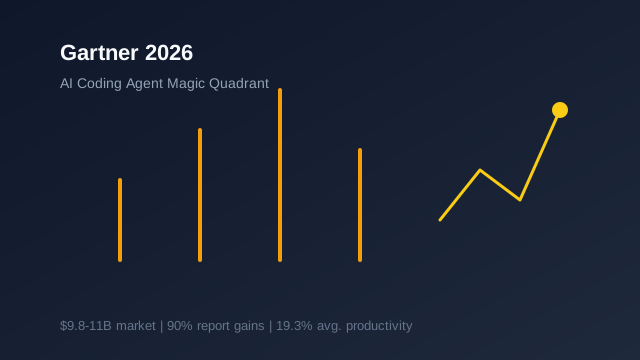
Gartner's May 2026 Magic Quadrant named Anthropic, Cursor, GitHub, and OpenAI leaders in a market now worth $9.8-11B. Here's what the numbers mean for how you staff and build.

OpenAI's Apps SDK (in-chat UI over MCP) versus Anthropic's Skills (packaged instructions Claude loads on demand) - what each actually requires from your team.

A concrete n8n workflow for WhatsApp order confirmations and abandoned-cart recovery - plus the opt-in and timing rules that keep you off Meta's ban list.

With foundation models commoditized, the AI startups that survive have data flywheels, workflow integration, and speed - not just model access.
AI coding tools generate code easily. What makes it useful for a real product is context - a persistent doc with your schema, flows, and decisions.

AI's most valuable use for a founder isn't generating code - it's accelerating customer discovery at scale.

AI coding tools removed the technical barrier to launching a SaaS product. What's left is the harder part - and the point where a solo operator needs engineering help.

Vibe coding vs. vibe engineering, defined clearly - plus the security and maintainability risks the difference actually protects against.

The concrete stack - Next.js, shadcn/ui, Supabase, Resend, Stripe, Vercel - and why each piece reduces decisions left to an AI agent's defaults.

The four building blocks a paid MVP needs that a loose prompt never asks for - foundation, data safety, billing, entitlements.

A walkthrough of exactly how a missing idempotency check on a payment webhook turns into duplicate charges at scale.
Prompt-Refactor-Verify: the discipline that keeps AI-assisted development fast without inheriting vibe-coding's fragility.

The metrics, structured logs, and alert thresholds that turn a notification pipeline from a black box into something debuggable.

Why true exactly-once delivery is impossible once a third-party provider is involved, and the idempotency-based alternative that works.
The dual-write problem explained, and how the outbox pattern with a relay worker guarantees your events actually get published.

Time-bucketed retries, dead letter queues, and circuit breakers - the three resilience patterns every integration needs.

What happens when a customer's card is charged but the warehouse can't fulfill the order - and how auto-rollback solves it.
A production architecture for SMS, email, and push: event-driven ingestion, priority queues, and the outbox pattern.

The write-first model for notification systems: persist an idempotency key before you ever call a provider.
Why @Transactional stops working across service boundaries, and how the SAGA pattern keeps distributed transactions consistent.
What the Luhn/MOD10 checksum actually validates (it isn't your phone number), and how libphonenumber, Twilio Lookup, Numverify, and GSMA Open Gateway fit together.

The real reason we open-sourced FinManage, our internal membership and subscription management platform, and what self-hosting it actually involves.
Doherty Threshold, Hick's Law, Fitts's Law, and more - the psychology-backed patterns that make business software feel intuitive.
Self-hosted WhatsApp automation with WAHA and n8n - verified pricing, real setup steps, and the ban risks most guides skip.
A practical transformation playbook showing how a B2B SaaS team shipped faster with AI-augmented engineering workflows.
A strategic view of how India became a core AI implementation engine across enterprise and public-scale systems.
An implementation-first framework for productionizing AI with governance, integration, and measurable outcomes.
Production-ready architecture for wildcard routing, tenant isolation, hybrid databases, and scale patterns for high-growth SaaS.
Build a watchdog architecture that sends alerts through cellular SMS even when your internet fails.
Pick the right revenue model, define upgrade triggers, and validate pricing without eroding trust.

Improve discoverability, conversion, and ratings with a structured ASO workflow.

Build acquisition, activation, and retention loops that raise revenue without heavy ad spend.
Connect research, UX architecture, and design systems into a repeatable delivery process.
Design dark themes that improve comfort, accessibility, and brand perception.
Test pyramid, tool selection (including Android-specific stacks), flakiness reduction, release gates, and how to evaluate a QA partner.
Understand the delivery systems and engineering quality needed for native mobile success.
Protect your invention with the right documentation, filing strategy, and IP planning.
Build an automated QA pipeline that protects critical journeys without slowing delivery.

What the last decade taught us about cloud, data, security, and operating models.
Move beyond basic automation with personalization, copilots, and AI governance.
A decision framework for native, cross-platform, or staged launches.

The product habits, growth loops, and retention mechanics behind top apps.

How to scale IoT systems safely with device management, security, and analytics.

Understand how storage, cache, and memory affect performance and user trust.
A modern stack that blends cloud-native architecture, DevOps, and observability.
A step-by-step roadmap from validation to launch and long-term growth.
The UX fundamentals that reduce friction, boost trust, and improve retention.
Structure discovery to align stakeholders, define scope, and de-risk delivery.
A complete primer on IoT components, use cases, and business value.
Define intelligent apps, the data foundation they require, and where to start.

How mobile learning improves access, engagement, and outcomes for learners.

Product and infrastructure considerations for launching a short-video platform.
A practical guide to offshore engagement models, governance, and outcomes.
We built it for advisory firms, coaching programs, and paid communities. Source is free to self-host - managed hosting if you want it.
The Knowledge Room covers mobile app engineering, AI/LLM implementation, cloud architecture, QA, and product strategy topics.
Yes. The content is written for practical implementation in regulated and scale-focused delivery contexts.
Yes. You can reach the team through the Partnership Gateway to discuss implementation and delivery planning.
Share your goals and we will send the most relevant guides for your team.